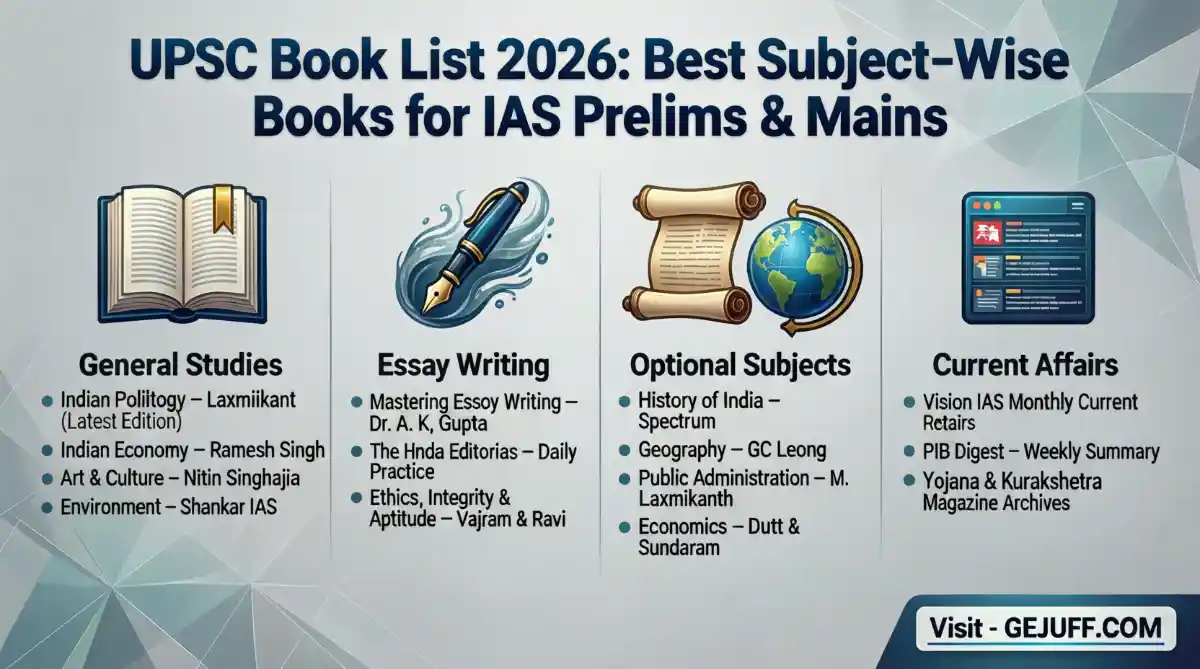

Preparing for the UPSC Civil Services Examination (CSE) is often described as a marathon, not a sprint. Every year, lakhs of aspirants begin their journey with high motivation, but only a few reach the finish line. One of the biggest reasons for failure is not lack of hard work, but poor book selection.
This comprehensive guide on the UPSC Book List 2026 is designed to help you avoid confusion, save time, and focus only on standard, trusted, and high-return resources. Whether you are a beginner or a serious repeat aspirant, this article will give you a clear, subject-wise, exam-oriented booklist for Prelims and Mains, along with strategy tips that toppers actually follow.
1. Why Choosing the Right UPSC Books Is Crucial
One of the biggest myths among UPSC aspirants is:
“The more books I read, the higher my chances of selection.”
This belief is completely wrong.
UPSC does not test how many books you have read; it tests:
Conceptual clarity
Analytical thinking
Application of knowledge
Interlinking of static and current affairs
If you keep changing books, you will:
Never complete the syllabus properly
Struggle with revision
Feel overwhelmed and demotivated
Successful candidates follow a limited-resources strategy:
1 standard book per subject
Multiple revisions
Strong linkage with current affairs
2. Understanding the UPSC Exam Structure
Before selecting books, you must understand what UPSC actually demands.
UPSC Exam Stages
Preliminary Examination
Objective (MCQs)
Two papers:
GS Paper I (Merit-based)
CSAT (Qualifying)
Mains Examination
Descriptive answers
9 papers (including Essay, GS I–IV, Optional)
Interview (Personality Test)
No fixed book list
Based on awareness, personality, and mindset
👉 Books are mainly required for Prelims and Mains.
3. UPSC Book List for Prelims (Subject-Wise)
Prelims is about breadth, accuracy, and elimination skills. Your book list should be concise and factual.
History (Ancient, Medieval, Modern)
Purpose: Build factual base + conceptual understanding.
Recommended Books:
NCERT History (Class 6–12)
Ancient & Medieval History (selective reading)
Modern Indian History (standard reference)
Focus Areas:
Art & Culture
Freedom struggle timelines
Socio-religious movements
👉 For Prelims, Modern History and Art & Culture are high priority.
Geography (Physical + Indian Geography)
Recommended Books:
NCERT Geography (Class 6–12)
One standard Physical Geography book
Atlas (very important)
Focus Areas:
Climatology
Indian rivers & resources
Maps and location-based questions
👉 Map-based questions are increasing every year.
Indian Polity & Constitution
This is the most scoring and most predictable subject.
Recommended Books:
One standard Polity book
NCERT Political Science (Class 9–11)
Focus Areas:
Fundamental Rights & Duties
Parliament & Judiciary
Constitutional bodies
👉 Revise Polity multiple times; questions are often conceptual.
Indian Economy
Recommended Books:
NCERT Economics (Class 9–12)
One basic economy reference book
Focus Areas:
Inflation, GDP, growth
Budget & Economic Survey (current relevance)
Banking & fiscal policy basics
👉 Economy is more conceptual than factual.
Environment & Ecology
High ROI subject with limited syllabus.
Recommended Books:
One standard Environment book
NCERT Biology (Class 11–12 – selective)
Focus Areas:
Biodiversity
Climate change
Environmental conventions
👉 Environment questions are often statement-based.
Science & Technology
No need for deep technical books.
Recommended Sources:
NCERT Science (Class 6–10 – basics)
Current affairs-based coverage
Focus Areas:
Space, biotech, IT
Government initiatives
Applied science
CSAT (Paper II – Qualifying)
Only practice-based preparation is needed.
Focus Areas:
Comprehension
Basic maths
Reasoning
👉 Do not ignore CSAT. Many candidates fail here.
4. UPSC Book List for Mains (GS Papers I–IV)
Mains is about depth, analysis, structure, and expression.
GS Paper I: History, Society & Geography
Books Required:
Same History & Geography books used for Prelims
Additional focus on:
World history (selective)
Indian society topics
Answer Writing Focus:
Use examples
Link past with present
Add diagrams/maps
GS Paper II: Polity, Governance & International Relations
Core Sources:
Polity reference book
Selective governance material
Current affairs for IR
Focus Areas:
Constitution in practice
Welfare schemes
India’s foreign policy
👉 GS II answers must be balanced and constitutional.
GS Paper III: Economy, Environment, Security & Technology
Core Areas:
Indian economy (advanced application)
Environment (same book, deeper analysis)
Internal security basics
Answer Writing Tip:
Use data (reports, indices)
Mention challenges + solutions
GS Paper IV: Ethics, Integrity & Aptitude
Most misunderstood paper.
Sources Needed:
One basic Ethics book
Case study practice
Focus Areas:
Ethics theories (basic)
Administrative values
Real-life examples
👉 Ethics is about thinking like a civil servant, not memorization.
5. NCERT Books for UPSC: The Foundation
If you ignore NCERTs, you are building your preparation on weak ground.
Why NCERTs Are Important:
Simple language
Concept clarity
UPSC uses NCERT terminology
Must-Read NCERTs:
History: Class 6–12
Geography: Class 6–12
Polity: Class 9–11
Economy: Class 9–12
Science: Class 6–10
👉 Read NCERTs at least twice.
6. UPSC Optional Subject Book List: How to Approach
Optional subject can make or break your rank.
How to Choose Optional:
Interest
Background knowledge
Availability of resources
Overlap with GS
Book Strategy for Optional:
1 basic book
1 advanced/reference book
Previous year question papers
👉 Do not collect multiple books for optional.
7. UPSC Book List for Beginners (Step-by-Step Plan)
Phase 1: Foundation (First 3–4 Months)
NCERTs only
Understand syllabus
Basic current affairs
Phase 2: Standard Books
Add 1 standard book per subject
Start note-making
Phase 3: Integration
Link static with current affairs
Start answer writing
8. How Many Books Are Enough for UPSC?
Ideal Number:
Prelims: 10–12 books (including NCERTs)
Mains: Same books + current affairs
👉 If your book list exceeds 15–18 books, you are overdoing it.
9. How to Read UPSC Books Effectively
Smart Reading Techniques:
Read with syllabus in hand
Highlight minimally
Make short notes
Revision Strategy:
3–4 revisions minimum
Use mind maps
Revise PYQs alongside books
10. Common Mistakes in UPSC Book Selection
Following multiple toppers blindly
Buying new books every month
Ignoring NCERTs
Not revising completed books
11. FAQs on UPSC Book List
Q1. Is NCERT enough for UPSC?
NCERTs are necessary but not sufficient. Standard books are required for depth.
Q2. Can I clear UPSC with self-study only?
Yes. Many toppers are self-study candidates.
Q3. Should I follow coaching booklists?
Use them as reference, not blindly.
Q4. Is one book per subject enough?
Yes, if revised properly.
#UPSCBookList2026, #UPSCPreparation, #IASExam, #CivilServicesExam, #UPSCPrelims, #UPSCMains, #IASPreparation, #UPSC2026
Check More- EduJobs&Yojana