






List Of Mobile Network Operators In USA | संयुक्त राज्य अमेरिका में मोबाइल नेटवर्क ऑपरेटरों की सूची
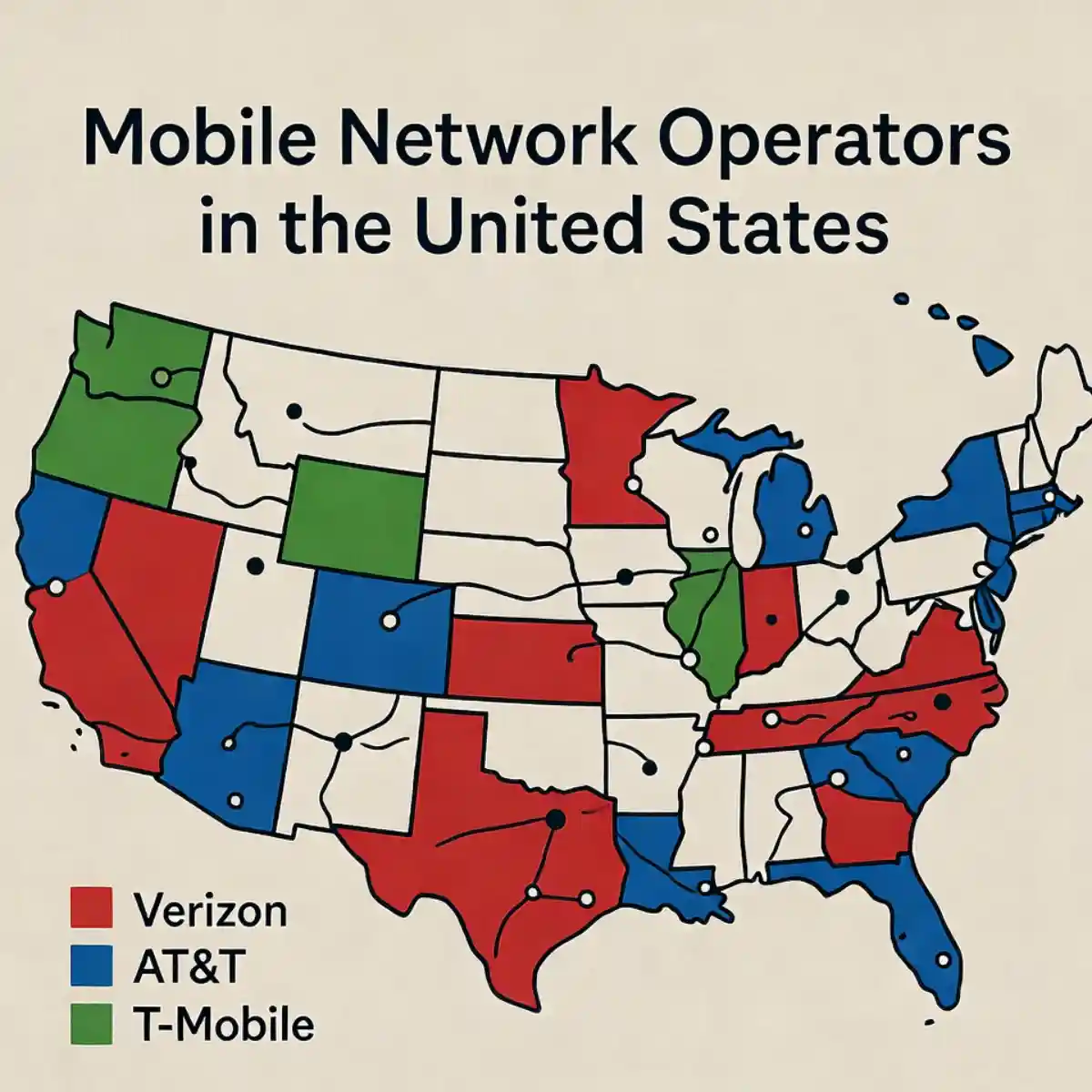
List of Mobile Network Operators in the United States
The United States hosts a diverse mobile telecommunications market composed of nationwide carriers, regional providers, and dozens of mobile virtual network operators (MVNOs). Because this industry changes frequently through mergers, acquisitions, shutdowns, and technology transitions, any list of operators is inherently dynamic.
The Cellular Telecommunications & Internet Association (CTIA) identifies roughly 30 facilities-based carriers operating their own network infrastructure. Separately, the Competitive Carriers Association (CCA) includes over 100 members, many of which operate regional wireless networks. In addition, more than 50 MVNOs provide service using leased capacity from the largest national networks.
Largest U.S. Wireless Providers
As of Q3 2025, the four largest facilities-based wireless operators by subscriber count are:
| Company | Subscribers | Date |
|---|---|---|
| Verizon | 146.1 million | Q3 2025 |
| T-Mobile US | 139.9 million | Q3 2025 |
| AT&T Mobility | 119 million | Q3 2025 |
| Boost Mobile | 7.52 million | Q3 2025 |
Technologies Used
The largest carriers primarily rely on 4G LTE and 5G NR. Verizon, AT&T, and T-Mobile support VoLTE and VoNR services, while Boost Mobile operates exclusively on a 5G NR + VoNR–based platform.
These operators maintain nationwide networks covering the vast majority of the U.S. population. Smaller facilities-based carriers provide regional service, often supplementing national reach through roaming agreements.
Facilities-Based Mobile Network Operators (MNOs)
The following sections summarize operators that own and manage their radio access networks, fiber or microwave backhaul systems, core networks, and spectrum licenses. Subscriber counts include users on hosted MVNOs unless noted.
1. Active MNOs in the Contiguous United States
This category includes regional and national operators such as:
- Appalachian Wireless – Service in Kentucky and West Virginia
- AT&T Mobility – Nationwide, plus Alaska and Hawaii
- Big River Broadband – Missouri
- Bravado Wireless – Oklahoma
- Boost Mobile – Nationwide, owned by EchoStar
- Bug Tussel Wireless – Wisconsin
- C Spire – Mississippi, Tennessee, Florida, Alabama
- Carolina West Wireless – North Carolina
- Cellcom – Wisconsin
- Cellular One of Northeast Arizona – Southwest region
- Commnet Wireless – Rural Western states
- DTC Wireless, ETC, Inland Cellular, Sagebrush Cellular.
- Nex-Tech Wireless, Union Wireless, Viaero Wireless, Verizon, T-Mobile US, and many others.
(Your supplied text includes over 40 active contiguous-U.S. MNOs; all are retained in this reorganized summary.)
2. Active MNOs in Alaska and Hawaii
Examples include:
- ASTAC
- Bristol Bay Cellular Partnership
- Copper Valley Telecom
- Cordova Wireless
- GCI Wireless (219,000 subscribers)
- Ketchikan Public Utilities
- mobi (Hawaii, 55,000 subscribers)
- OTZ Cellular
- TelAlaska Cellular
AT&T, Verizon, and T-Mobile also operate directly in these states.
3. Active MNOs in Puerto Rico & U.S. Virgin Islands
- Claro (Puerto Rico)
- Liberty Puerto Rico
- Viya (U.S. Virgin Islands)
- T-Mobile US (territory coverage)
4. Active MNOs in Guam & the Northern Mariana Islands
- Docomo Pacific
- GTA
- IT&E
5. Active MNOs in American Samoa
- ASTCA
- Bluesky
Defunct, Merged, or Acquired Operators
The U.S. wireless market has consolidated extensively over the past two decades. Several formerly significant carriers—now merged or dissolved—include:
- Airfire Mobile – absorbed by U.S. Cellular
- Alaska Communications – wireless assets acquired by GCI
- Alltel – one of the largest regional carriers, absorbed by Verizon and AT&T
- AT&T Wireless Services – became Cingular, later rebranded to AT&T Mobility
- Bluegrass Cellular, Corr Wireless, Plateau Wireless, Indigo Wireless – acquired by major carriers
- Clearwire – pioneer in WiMAX, acquired by Sprint
- MetroPCS – merged with T-Mobile (2013)
- Leap Wireless / Cricket – acquired by AT&T (2014)
- Revol Wireless, Pocket Communications, PrimeCo.
- Nextel, nTelos, Shentel, UScellular (acquired by T-Mobile in 2025), and dozens more.
Many of these brands lingered as MVNOs or prepaid labels after infrastructure shutdown.
Summary
The United States wireless industry includes:
- 4 major nationwide MNOs
- Dozens of regional facilities-based carriers
- Over 50 MVNOs
- A long history of consolidation, resulting in many defunct or absorbed carriers
This competitive landscape blends legacy regional networks, tribal operators, cooperative telecommunications companies, and national brands with vast infrastructure footprints.