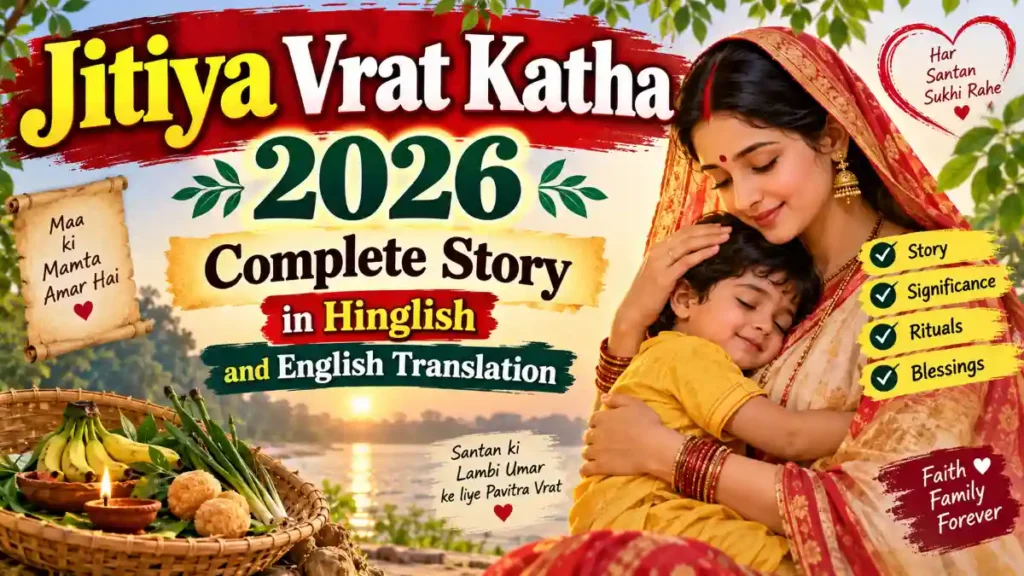
Jivitputrika Vrat (popularly known as Jitiya) is one of the most rigorous and sacred fasting rituals observed by Hindu mothers for the longevity, health, and prosperity of their children. Observed during the Krishna Paksha of the Ashwin month, this three-day festival requires mothers to observe a strict 24-hour Nirjala (without water) fast.
If you are an NRI devotee or an urban millennial who struggles to read traditional Devnagari script on your phone during the evening puja, this complete bilingual guide has everything you need. Below you will find the 2026 Shubh Muhurat timings, the authentic Jitiya Vrat Katha in Hinglish for easy recitation, and a clear English translation
Jitiya Vrat 2026 Calendar & Tithi Timings
- Day 1: Nahay-Khay (Friday, 2 October 2026): Mothers consume a single, pure sattvic meal after bathing to clean the body and mind.
- Day 2: Jitiya Main Nirjala Fast (Saturday, 3 October 2026): The core fasting day where the evening puja is performed and the Katha is read.
- Ashtami Tithi Begins: 3 October 2026 at 07:59 AM.
- Ashtami Tithi Ends: 4 October 2026 at 05:51 AM.
- Day 3: Parana / Fast Breaking (Sunday, 4 October 2026): The fast is safely broken after the Ashtami Tithi concludes in the early morning.
🔴 Part 1: Jitiya Vrat Katha (Easy Hinglish Text for Puja)
Ek samay ki baat hai, Gandharvon ke ek bohot hi dayaalu aur daanveer raja the, jinka naam Jimutavahana tha. Unhe raj-paat aur vaibhav ka koi moh nahi tha. Isliye, unhone apna sara rajya apne bhaiyon ko saunp diya aur swayam van mein sadhna karne chale gaye.
Us vriddha mata ne rote hue bataya, “Mera naam Nagvanshi hai. Pakshiraj Garuda ke dar se humara ek samjhauta hua hai, jiske tehat har roz ek naag ki bali di jaati hai. Aaj mere akele bete, Shankhachuda, ki bali ki baari hai. Main apne eklaute bachhe ko kaise marne doon?”
Jimutavahana us chattan par let gaye jahan bali di jaati thi. Kuch hi der mein pakshiraj Garuda aaye aur unhe apne panjo mein dabo kar aakash mein ud gaye. Lekin Garuda ne dekha ki unka shikaar darr ke maare rone ya chilane ki bajaye bilkul shant hai aur ishwar ka naam le raha hai.
Garuda ne hairan hokar pucha, “Tum kaun ho? Aur tum maut ke samne itne shant kyun ho?” Jimutavahana ne unhe saari sachai batayi. King Jimutavahana ke is tyaag, sahas aur paropkar se prasanna hokar, Garuda ne unhe jeevan daan diya aur vachan diya ki woh bhavishya mein kabhi kisi Naag ki bali nahi lenge. Tabhi se, bachon ki lambi umar aur raksha ke liye Jitiya Vrat rakhne aur yeh katha sunne ki parampara chali aa rahi hai
🔵 Part 2: Complete English Translation & Meaning
One day, he encountered an elderly mother from the Nagvanshi (serpent) clan weeping bitterly. Moved by her grief, Jimutavahana approached her and asked, “Mother, what causes you such deep sorrow?”
The mother replied, “To protect our clan from the wrath of the king of birds, Garuda, we have a pact to sacrifice one serpent to him every day. Today, it is the turn of my only surviving son, Shankhachuda. I cannot bear the thought of losing him.”
Filled with profound compassion, King Jimutavahana comforted her and said, “Do not weep, mother. I will protect your son by offering my own body on the sacrificial altar today.” He then lay down on the rock where the sacrifices took place. Soon, Garuda swooped down, clutched him in his sharp talons, and flew into the sky.
As they flew, Garuda noticed something extraordinary: his prey was not screaming, crying, or begging for mercy. Instead, the man was completely serene, smiling, and silently chanting prayers. Astounded, Garuda paused and asked, “Who are you? Why do you display no fear in the face of death?”